Search "One Day in Shenzhen"

Custom Search
Showing posts with label Historical Sites. Show all posts

Old Dongmen

This article was originally published on September 3, 2010, in the Shenzhen Daily.
The information was accurate at that time, and may be outdated now. Use with caution.

Dongmen is even older than China's first McDonalds (pictured here)
Few places in Shenzhen are as modern as the Dongmen shopping area. But did you know that two outposts of Shenzhen's history can be found here? Siyue Shuyuan and the Zhang Ancestral Hall are each around 300 years old--as old as the Dongmen shopping area itself.

List of Revolutionary Tourist Attractions

This list was published in the Shenzhen Daily on June 3, 2011. Many of the sites listed here are covered by my articles; others are not. The larger article on that page, "Revolutionary tourist attractions in SZ (Part I)," as well as "Part II," give a little more background on each site, and what makes it "revolutionary." Enjoy!

Hakka Houses in Longgang

This article was originally published on January 28, 2011, in the Shenzhen Daily.
The information was accurate at that time, and may be outdated now. Use with caution.

Main gate of Dawan Dwelling
I've written before of the Crane Lake Dwelling Hakka House Museum in Longgang Town, and of Dapeng Fortress.

But did you realize that, aside from these two, Longgang boasts about 100 other walled villages?

Maosheng Residence, Henggang

This article was originally published on September 26, 2011, in the Shenzhen Daily.
The information was accurate at that time, and may be outdated now. Use with caution.

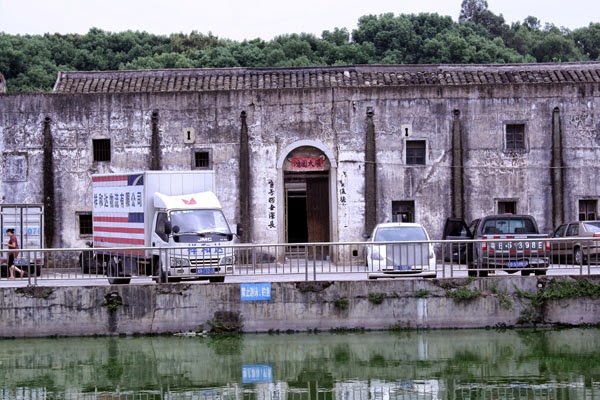
Maosheng Hakka Residence, with a pond in front and forest behind
One of the hidden treasures in our city is the large number of Hakka enclosed villages (or "Hakka houses"). There are dozens of them in Longgang, and the new Metro line brings them much closer.

Crane Lake Dwelling Hakka House Museum

This article was originally published on May 24, 2010, in the Shenzhen Daily.
The information was accurate at that time, and may be outdated now. Use with caution.

The front gate at the Crane Lake Dwelling Hakka House Museum
The Hakka people, a sub-culture of the Han Chinese, have long been an integral part of the Shenzhen scene. Because they settled here later than the earlier Han populations, the group's name means "Guest People."

Beidi Temple, Xixiang

This article was originally published on April 1, 2011, in the Shenzhen Daily.
The information was accurate at that time, and may be outdated now. Use with caution.

This hall is surrounded on three sides by an elementary school
There's a little-discussed area out in Bao'an, Xixiang by name. Modern buses and cars speed past it on the Guang-Shen Expressway from central Shenzhen to Guangzhou; but what a lot of history it holds!

Dapeng Fortress

This article was originally published on June 7, 2010, in the Shenzhen Daily.
The information was accurate at that time, and may be outdated now. Use with caution.

The main gate of Dapeng Fortress
Longtime Shenzheners may have heard our fair city nicknamed "The Roc City," the roc being a large, mythical bird. The name is a translation of "dapeng cheng (大鹏城)," or Dapeng Fortress, one of Shenzhen's most spectacular historical sites. (Others say it's because the city looks like a giant bird from the air; I suspect this explanation came later.)

Two Temples in Dapeng

This article was originally published on December 31, 2010, in the Shenzhen Daily.
The information was accurate at that time, and may be outdated now. Use with caution.

NOTE (added September, 2019): This temple has undergone a massive transformation. The Daoist-style temple shown here is gone, replaced by a gorgeous modern Buddhist temple.

The former front hall at Dongshan Temple (probably gone now)
The ancient fortress at Dapeng is justifiably one of Shenzhen's best-known attractions. But the area around Dapeng Town boasts two more excellent destinations, both of which are Buddhist temples.

Guanlan Market

This article was originally published on June 3, 2011, in the Shenzhen Daily.
The information was accurate at that time, and may be outdated now. Use with caution.

Detail of the 1923 Gongyi Hotel in Guanlan Market
Modern visitors to Guanlan might never suspect the role it played a hundred years ago. But the small river here runs north all the way to Guangzhou and thence into the Pearl, making more believable the idea that this was once one of the four main markets of Shenzhen.

The Bao'an Labor Museum

This article was originally published on May 6, 2011, in the Shenzhen Daily.
The information was accurate at that time, and may be outdated now. Use with caution.

A statue in the courtyard of the Bao'an Labor Museum depicts Shenzhen's workers
On the bus to my regular visits to the smell Buddhist temple at Shiyan Lake, I have often seen a sign in Shiyan announcing the "Shenzhen (Baoan) Labor Museum." Finally, on this Labor Day weekend, I decided to jump off the bus and have a look.

Chun Niu Tang and a Mazu Temple

This article was originally published on August 20, 2010, in the Shenzhen Daily.
The information was accurate at that time, and may be outdated now. Use with caution.

The one remaining hall at Chun Niu Tang
Some of Shenzhen's oldest buildings are found in Nanshan. I've chronicled some of these before, and today we'll visit two more: the Chun Niu Tang or "Spring Cattle Hall," and an old Mazu Temple.

Hidden Xin'an Ancient City

This article was originally published on May 17, 2010, in the Shenzhen Daily.
The information was accurate at that time, and may be outdated now. Use with caution.

The front hall of Xuanwu Temple in the foreground; the rear hall is farther back
The "Xin'an Gucheng" (old city) in Nantou is rather well known. The museum located on the north side of Shennan at Nanxin Road gives a good interpretation of the area that lies to its northeast, bordering Zhongshan Park.

But did you know that, southwest of the Walmart Neighborhood Store, more remnants of the "gucheng" still remain?

Xin'an Ancient City

This article was originally published on October 18, 2010, in the Shenzhen Daily.
The information was accurate at that time, and may be outdated now. Use with caution.

This modern pailou on Shennan Road marks the entrance to the Nantou Ancient City
Next to Zhongshan Park in Nanshan lies one of Shenzhen's greatest treasures, the Xin'an Ancient City. It has been a government seat off and on since 331, with its heyday in the Ming Dynasty when it became Dongguan Castle.

The Tomb of Huang Motang

This article was originally published on November 26, 2010, in the Shenzhen Daily.
The information was accurate at that time, and may be outdated now. Use with caution.

Huang Motang's tomb rests in a quiet place on the back of Lianhua Shan

In other posts we've visited the Huang family museum in Xiasha Village, and the Huang Ancestral Hall in Shang Meilin. These are both connected to one figure, Huang Motang, whose descendants settled both of those villages, and several others.

Shenzhen History Museum

This article was originally published on September 24, 2010, in the Shenzhen Daily.
The information was accurate at that time, and may be outdated now. Use with caution.

The Shenzhen Museum sits under the east end of the City Hall
(Shimin Zhongxin") complex. Entrance is around the corner in this shot.

Although the Shenzhen History Museum opened in late 2008, I just recently visited it for the first time. And it's nothing short of world-class.

Left Fort, Chiwan

This article was originally published on March 4, 2011, in the Shenzhen Daily.
The information was accurate at that time, and may be outdated now. Use with caution.

Entrance to the barracks area; the gun platform is up some stairs inside.
Once again, we find that the "brand-new" city of Shenzhen has much deeper roots than we suspected.

On the way to Chiwan on the 226 bus (which you can now catch at Shekou Sea World stop [海上世界] on the new Shekou Metro Line) there is a stop called Zuo Pao Tai (左炮台), or "Left Fort" (literally "Left Cannon Platform"). If you get off there and walk up the road winding around the nearby hill, you'll find the partially-restored remains of a gun emplacement from the days of the Anglo-Chinese Wars or "Opium Wars" of the 19th century.

Tianhou Temple, Chiwan

This article was originally published on July 23, 2010, in the Shenzhen Daily.
The information was accurate at that time, and may be outdated now. Use with caution.

The main hall at the Tianhou Temple, Chiwan

The Tianhou Temple (or Tianhou Gong, 天后宫) at Chiwan is the largest of its type in Guangdong. Dating back to the Northern Song Dynasty (960-1127), the temple was really "put on the map" by the Ming admiral Zheng He.

The "Site of the Merits"

This article was originally published on February 8, 2010, in the Shenzhen Daily.
The information was accurate at that time, and may be outdated now. Use with caution.

Ornate front gate of the "Site of the Merits," an old walled village in Sungang
When friends say "Shenzhen has no historical buildings," I like to take them to the walled village known as "The Site of the Merits."

Historical Site Series from the Shenzhen Daily

This list has been recovered from the files used to create my old homepage, the Shenzhen Buzz.

From December 2006 to May 2007, the venerable Shenzhen Daily published a series of articles on the city's historical sites, in cooperation with the Shenzhen Administration of the Preservation of Cultural and Historical Relics.

Song Shao Di Mu, Tomb of the Last Song Emperor

This is a longer version of an article that was originally published on April 19, 2010, in the Shenzhen Daily. I have added to it from another of my pages here on jamesbaquet.com. I last visited the site in 2013, and it was substantially as described here.

The tomb of Song Shao, last of the Song emperors. The peculiar shape of the tomb is meant
to emulate a woman's legs; the placing of ashes in the door simulates a return to the womb.
Shenzhen is a newly-developed city, but if you look closely, you can still find some history.

Case in point: Song Shao Di Mu, the tomb of Song Shao (also called Song Di Bing or Zhao Bing), last emperor of China's Southern Song Dynasty, who died in the Pearl River Delta in 1279 and whose body, it is said, washed up on the shores of Shenzhen.